
The Silicon Vault
And the Long-Overdue Death of the Correspondent Bank Wire

The modern corporate treasury is no longer a physical safe in Central, Hong Kong. It's a cryptographically bound hardware enclave floating on a distributed ledger.
Let's be brutally honest for a moment. Corporate cross-border banking in Asia is a contradiction. We sit in smart cities with high-speed autonomous rail networks and ultra-broadband, yet routing a commercial payment from Hong Kong to Dubai takes three agonizing days. It involves an intermediary bank in New York - asleep when we are awake - slicing off $150 in unpredictable "lifting fees" for the sheer privilege of forwarding a SWIFT textfile.If you've ever managed a multi-national treasury, you know the dread of a trapped wire on a Friday afternoon. You know the paperwork required just to open a subsidiary account in Singapore or Vietnam.Our balance sheets demand better. The geopolitical realities of trans-Pacific trade demand velocity.This is the story of Meridian Pacific Trading, an Asian supply-chain giant headquartered in Hong Kong. It's the story of how their executive team bypassed the archaic banking cartel using a silent, beautiful machine called the nuPorte Corporate Cross-Border Payments Engine. A platform built not of legacy bureaucracy, but of cryptographic certainty, zero-trust hardware, and the staggering speed of the Stellar blockchain.
Chapter One: The Ghost in the Silicon
Eleanor Chen, the CFO of Meridian Pacific, sat in her high-rise office overlooking Victoria Harbour. The quarterly supplier run was due across eight different countries. Usually, this meant logging into four different banking portals with a stack of physical 2FA hardware dongles that looked like they belonged in a 1990s IT museum. Instead, she opened the nuPorte gateway. She entered her corporate credentials. Now came the moment of truth. True digital sovereignty shouldn't require memorizing a 24-word "seed phrase" and hiding it in a safety deposit box. Eleanor didn't have time for that nonsense. She clicked "Initialize Hardware Passkey." Instantly, the background architecture - an incredibly dense WebAuthn FIDO2 Level 3 gateway - whirred to life. It didn't ask for a password. Instead, the native macOS Secure Enclave prompted her. She rested her finger on the MacBook's Touch ID sensor. In that millisecond, a private key was birthed directly inside her laptop's physical silicon. It was non-extractable. Un-hackable. Not even the nuPorte server knew what it was. Her laptop itself was now the ultimate master key to a deterministic Soroban Smart Contract deploying instantly on the ledger. Her screen flashed an emerald alert: 100% Security Score.
"The system doesn't trust a password. It doesn't even trust the nuPorte server. It explicitly trusts the physical physics of the silicon beneath her fingertips."
But an empty vault is useless. Eleanor clicked "Establish Missing Trustlines." With a single atomic operation across the ledger, the system bound her smartcontract to USDC, USDT, Digital Hong Kong Dollars (HKD), Singapore Dollars(SGD), Emirati Dirham (AED), and four other sovereign fiat tokens. Nine regional currency rails activated simultaneously. No multi-week KYC approvals. Just cryptographic opt-in.
Chapter Two: The Omni-Channel Sluice

Liquidity doesn't respect bank hours. It streams in through IPG cards, commercial wires, and regional mobileQR codes simultaneously.
A smart vault requires working capital. In Singapore, Meridian's Head of Treasury Operations, Kenji Sato, took over. Kenji didn't just wire funds; he orchestrated a multi-regional symphony of capital. First, an emergency top-up for immediate dollar liquidity. Kenji typed $50,000 USD from an enterprise credit card into the IPG gateway. Authorized. A seamless API call bypassed the fiat delays, minting 50,000.0000000 USDC directly into the corporate vault with T+0 finality. Next, heavy commercial liquidity. Kenji initiated a massive SEP-24 gateway deposit to pull in working capital from the US. The platform instantly negotiated an interactive bridge with an institutional US anchor, generating a unique transaction UUID and a direct Fedwire routing ABA number. He pushed the wire. Boom. The vault lit up. Finally, Kenji leveraged nuPorte's true regional power: ASEAN QR Ingress. While on a business trip in Bangkok, he needed to sweep some local receivables. He opened the nuPorte Treasury terminal, selected Thai PromptPay (THB), and generated an EMVCo-compliant MPM QR code with a mathematically flawless CRC16 checksum. A quick scan from a local Thai mobile banking app pushed the funds, instantly crossing borders and minting pristine Digital Dollars into Meridian's vault back in Hong Kong. He opened the ECharts Vault Allocation Donut. Liquid assets sitting perfectly allocated across USD, HKD, and Stablecoins. Real-time. No "pending clearance" float. No bank reconciliation lag.
Chapter Three: The Dongguan Lockbox
Meridian needed to settle an invoice with Dongguan Precision Robotics in Mainland China. There was a glaring problem: Dongguan was a legacy manufacturer. They had no idea what "Stellar" or "Smart Contracts" were, and they certainly didn't have a pre-configured digital dollar wallet. In the legacy world, a wire to a new Chinese supplier can be caught in capital control nets for days. Instead, Kenji navigated to the Intra-Network Rails. He utilized a protocol masterpiece: a CAP-0023 Claimable Balance Escrow. Kenji locked $15,000 USDC into a frictionless, non-custodial smart lockbox on-chain. He emailed a magic redemption web link to Dongguan's finance manager viaWeChat. In Dongguan, the manager clicked the link. The nuPorte interface welcomed him, showing a beautiful verification badge and $15,000.00 USDC locked and waiting. He clicked "Establish Trustline & Sweep Funds." Behind the scenes, the protocol performed an atomic multi-operation miracle. In exactly 3.4 seconds, the system autonomously woke up Dongguan's dormant account, forced the creation of a USDC currency sub-account, dissolved Kenji's escrow lockbox, and mathematically settled the cash. The vendor didn't need IT support. They didn't need a crypto manual. Themoney was simply yours.
Chapter Four: The Sixty-SecondHeartbeat
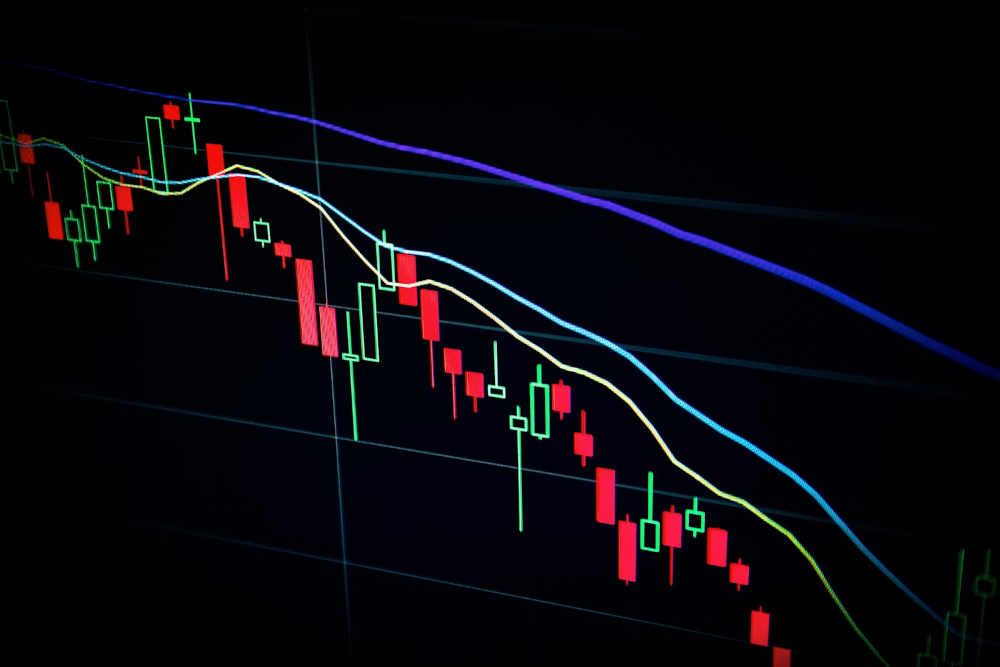
While correspondent banks batch MT103 wires overnight, nuPorte captures exact-second FX rates without spread manipulation.
The crown jewel of Meridian's afternoon was a $250,000 commercial disbursement to Falcon Heavy Logistics FZCO in Dubai. Eleanor wanted it cleared by the close of business in the Middle East. Enter the SEP-31 GlobalPayout Engine. Eleanor selected the vendor. The system dynamically interrogated a regulated hybrid anchor in the UAE. A Quote Hero Card appeared. It wasn't an "estimate"- it was a mathematically binding cryptographic contract.
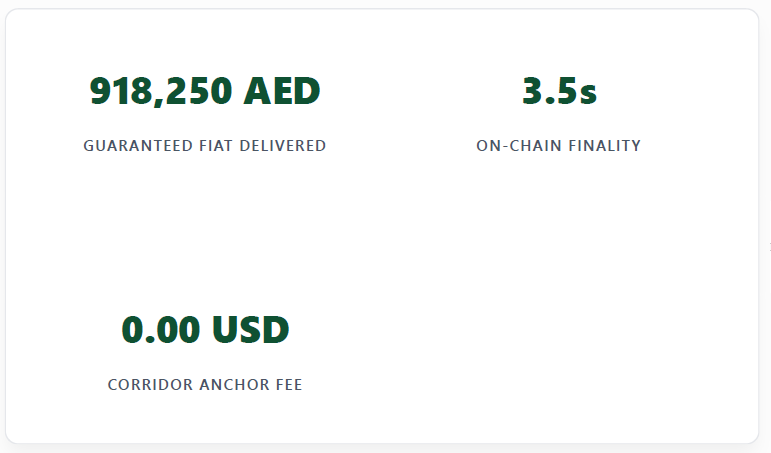
At the bottom of her screen, an emerald progress bar began shrinking. The Time-To-Live (TTL) countdown. She had exactly 60 seconds to authorize before the live FX rate evaporated. At 15 seconds, the bar shifted to an anxious amber. At 5 seconds, a frantic coral. Eleanor rested her thumb on the Touch ID sensor. The transaction fired. The status tracker lit up. The platform dispatched the USDC on-chain with an immutable deposit memo. The Dubai anchor caught the packet, swapped it at the exact locked peg of 3.6730 AED, and dropped it into the UAE Central Bank RTGS clearing system. The tracker flashed: Settled & Delivered (Gulf Clearing Finality). Total execution time from her laptop in Hong Kong to a local bank account in Dubai? Minutes.
Chapter Five: The Deflationary Flywheel
Wait, the best part isn't the speed. It's the byproduct. Legacy banks treat your cross-border lifting fees as pure profit. nuPorte treats your spending volume as corporate equity. Because Eleanor authorized that massive $250,000 wire while Meridian held 'ENTERPRISE' tier status, the protocol ran a quiet mathematical calculation in the background. Boom. +3,750.0000000 PORTE Loyalty Tokens minted synchronously into Meridian's sovereign vault. A true double-entry database transaction committing both the payment and the loyalty yield at the exact same microsecond. Later that day, feeling spiteful toward the concept of "banking fees", Eleanor opened the Tokenized Loyalty dashboard. She selected 5,000 PORTE tokens and initiated a Platform Fee Credit Liquidation. The tokens were physically transferred to an un-spendable 'Burn Vault' on the blockchain - irreversibly decommissioned from the global supply. In exchange, the database issued her a $50.00 USD Platform Fee Credit. On her next wire run to a vendor in Vietnam, she watched the UI draw a satisfying strikethrough over the $15.00 anchor clearing fee. $15.00 $0.00. A completely fee-less cross-border disbursement to Ho Chi Minh City, subsidized entirely by the protocol's own mathematical flywheel.
Chapter Six: The Omniscient Ledger
In a glass office down the hall, Mei Lin, Head of Risk, was analyzing the Arbitrage Observatory. Normally, month-end reconciliation meant weeping over disparate ERP files trying to match SWIFT logs with missing FX deductions. Instead, she was looking at a high-performance Apache ECharts dashboard streaming real-time telemetry from an isolated PostgreSQL read-replica pool.The UI never froze, never choked, even as it ingested thousands of enterprise transactions. She hovered over the 30-Day Cost Divergence Curve. The blue line of legacy SWIFT expenses arched brutally upward. The emerald green line of nuPorte execution costs sat flat against the floor. The shaded region between them? $14,589.96 in direct corporate cash preserved this month alone, plus thousands recovered in working capital float. Mei Lin clicked into the Forensic On-Chain Ledger. It was a beautiful, DataTables-powered ledger of INBOUND and OUTBOUND traffic. She clicked the 64-character transaction hash next to the Dubai payout. A new tab snapped open to the Stellar. Expert block explorer, verifying the transaction memo, the signature, and the 100-stroop gas fee. There was no trusting a banking middleman. The mathematics proved it.
Epilogue: Moving at the Speed of Light
Upstairs, Meridian's treasury team reviewed the week. They had capitalized via ASEAN QR codes, sidestepped intermediary banks on trans-Pacific SWIFT runs, paid unbanked vendors in China using frictionless claimable escrows, and literally burned loyalty tokens to eliminate global processing fees. Meridian Pacific Trading had broken the chains of 1970s banking infrastructure. Their working capital was no longer held hostage in transit overlong Asian holidays just so correspondent banks could capture overnight float yield. Their treasury was highly programmable. Their vault access was bound to the raw physical silicon of their own laptops. And their capital? It was finally moving at the speed of the internet.